Disclaimer
This article is educational only and provides general tax information. It is not tax, legal, or financial advice, and it does not replace advice a dedicated meeting with CPA, accountant, or other tax professional. Tax rules differ between the United States, Canada, the United Kingdom, and other jurisdictions, and they also vary based on your entity structure, residency, contracts, and filing history. For official guidance, review the following:
- IRS self-employed resources
- IRS page for Form 1099-NEC
- the CRA self-employed guidance
- the CRA business expenses page
- and HMRC Self Assessment guidance

We’ve also asked William Eckhart, CPA of RetreatsandVenues.com; a corporate retreats company – to provide feedback on the content and ensure it’s accuracy and authenticity.
Most articles about creator finance still talk like tax is a footnote to growth. That framing is outdated. Today, creators are not just posting into Instagram niches for reach; they are building real commercial systems around Instagram monetization, Instagram shopping integrations, Instagram affiliate marketing, and conversion-led Shoppable content. The same person learning How instagram algorithm works may also be testing Monetize Instagram reels, evaluating Instagram vs. Tiktok Monetization, deciding whether to Link shopify to instagram, and comparing Macro vs. Micro influencers on Instagram as part of a broader growth model. At that point, they are not casually earning online. They are operating like a small business with real tax obligations.
That distinction matters because tax systems care less about creator culture than they do about economic reality. If a person is receiving brand deals, earning from affiliate marketing, collecting subscription revenue, or accepting products in exchange for sponsored content, tax authorities usually look at whether there is an intention to profit and whether the activity produces business income or self-employment income. In the United States, that can pull creators into federal income tax, self-employment tax, social security, medicare, and sometimes state tax considerations. In Canada, it typically means reporting self-employed or business income through the CRA framework, with record-keeping doing most of the heavy lifting.
Do Instagram Creators Have to Pay Taxes?
The conservative answer is yes. If you earn money or receive valuable compensation through Instagram, that income is generally taxable in both the United States and Canada. That includes brand deals on instagram, commissions from Instagram affiliate marketing, bonuses, subscriptions, and in some cases free products or trips when they are tied to promotional services. The IRS states that self-employed individuals generally must file a federal return if net earnings from self-employment are $400 or more, and it also explains that self-employment tax consists primarily of Social Security and Medicare taxes for people who work for themselves. The CRA likewise treats profit-oriented activity as business activity and provides guidance for small businesses and self-employed individuals on reporting that income.
That is why the questions arise like “Do Instagram influencers pay taxes?” and “Do I have to pay tax on Instagram?” are not really complex from a high-level publishing standpoint. If the activity is commercial, recurring, and tied to a profit motive, the safest editorial position is that the creator likely has a filing and reporting responsibility. The harder and more useful question is how that income should be classified, documented, and planned for. That is where ecommerce-style operating discipline becomes more valuable than generic creator advice.
“Income earned from Instagram is generally considered taxable income in most jurisdictions, including the United States and Canada. This includes brand deals, affiliate income, bonuses, subscriptions, and even certain gifts if received in exchange for promotional activity.” — William Eckhart, CPA
What Counts as Taxable Instagram Income?
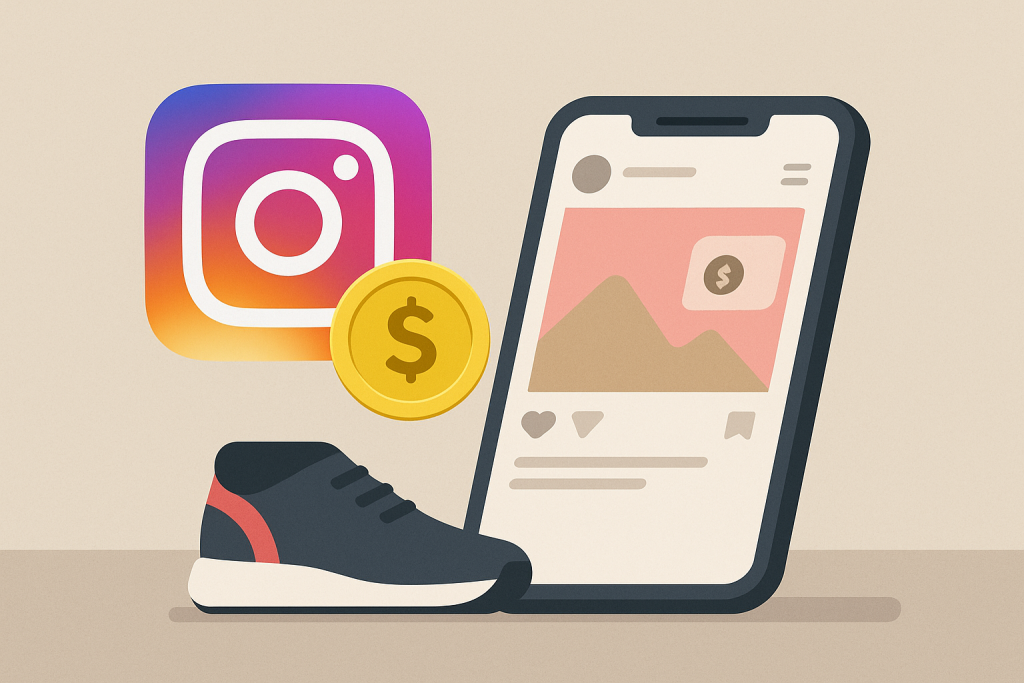
The part many content creators underestimate is how broad taxable income can be. It is not limited to cash from one-off sponsorships. A creator might earn from sponsored posts, recurring brand partnerships, commissions from affiliate marketing, creator bonuses, tips, subscriptions, direct product referrals, or performance-based sales once they Link shopify to instagram and start sending users into more transactional experiences. A creator focused on Shoppable instagram, Shoppable galleries, or Shoppable UGC may be building a more conversion-oriented business than a media brand, but tax law still asks the same basic question: what value did the creator receive in exchange for commercial activity?
This is where the gap between creator language and tax language becomes expensive. Creators often talk in channel terms: Instagram bonuses, Tiktok monetization, affiliate payouts, and brand retainers. Tax systems collapse those categories into reporting questions about gross income, taxable income, documentation, and whether the payer issued a tax form. In the U.S., some creators may receive Form 1099-NEC for nonemployee compensation, and some payments routed through processors may trigger other reporting mechanisms, but the IRS makes clear that the existence of a form is not what makes the income taxable. The income is reportable because it was earned.
The Canadian version of that problem is different in form but not in substance. Because creators often do not receive a neat equivalent to every U.S.-style information return, they sometimes assume small amounts or scattered payments do not count. That is risky. CRA guidance makes clear that self-employed people are expected to report their income and keep records. In practical terms, that means the creator’s own systems—bookkeeping, invoices, receipts, payout logs, and campaign records—often matter more than whatever a platform happens to send.
Brand Sponsorships, Affiliate Marketing, and Platform Payments
From a growth standpoint, not all income streams are equal. A creator who specializes in UGC examples on Instagram may have a very different margin profile from one whose business is built around higher-ticket brand deals or deep Instagram shopping integrations. The creator who sells through Shoppable content and a connected storefront might have stronger downstream economics than the creator who depends on one-off sponsorships. But tax reporting does not care very much about the story you tell yourself about the channel. If the payments are tied to your work, they usually fit inside the reporting framework for self-employment or business activity.
This is why mature creator businesses have to think more like ecommerce businesses. A campaign fee is not just revenue. It is revenue minus production cost, minus contractor support, minus platform tooling, minus future tax liability. A strong topline can still create weak outcomes if the creator is not reserving cash for estimated tax payments, not modeling quarterly tax, and not understanding how much of that payment is actually theirs to keep. In practice, this is the same unit-economics discipline that operators already apply to paid media, discounting, and retention.
Gifts, PR Packages, Tips, and Subscriptions
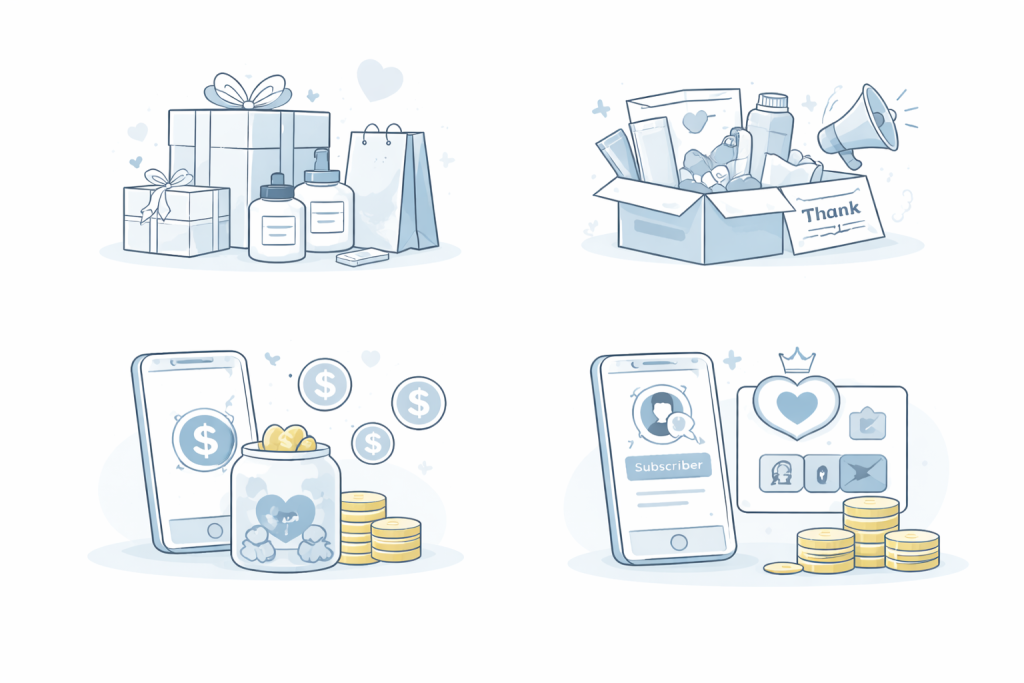
One of the easiest ways to misstate creator income is to ignore non-cash compensation. A product that feels like a gift may still be compensation if it was sent with an expectation of posting, reviewing, or otherwise promoting the brand. That matters for beauty, fashion, travel, wellness, and tech creators especially, because their businesses often sit inside a steady stream of PR outreach, comped services, or product seeding. The more normal that becomes operationally, the easier it is to forget that barter income can still be income.
“Gifted products or PR packages can be taxable when they are provided in exchange for promotional activity or services. If a brand sends products with an expectation of posting, reviewing, or advertising, the fair market value may be considered taxable income.” — William Eckhart, CPA
This is also why the question “Do influencers pay tax on gifts?” cannot be answered responsibly with a blanket no. If the product was compensation for services, the fair market value may need to be included in the creator’s reporting. If the item was unsolicited and there was no agreement or obligation, treatment can differ, but that is a facts-and-circumstances issue, not something a public article should oversimplify. For trust and compliance purposes, conservative framing is better than catchy framing.
How Instagram Income Is Usually Classified
For most serious creators, Instagram income is usually classified as self-employment income or business income, not hobby income. The decisive factor is not whether the creator is famous, but whether the activity is being carried on with a reasonable expectation of profit. A person regularly negotiating campaigns, earning affiliate commissions, producing sponsored content, and operating with a commercial cadence looks much more like a business than a hobbyist. In the U.S., independent contractor income is generally reported on Schedule C, and most self-employed individuals may need to pay self-employment tax if their net earnings are high enough.
“Instagram income is typically classified as self-employment or business income when the creator operates with a reasonable expectation of profit. If a creator regularly promotes products, negotiates brand deals, or earns affiliate commissions, tax authorities usually consider this a business activity.” — William Eckhart, CPA
This classification matters because it changes everything downstream. It affects whether a creator is thinking about business tax rather than casual side income, whether they need to plan around estimated tax payments, whether they can claim appropriate tax deductions, and how seriously they should treat record-keeping. It also changes the tone of the business itself. The moment someone starts behaving like a commercial operator, amateur finance systems become the weakest part of the stack.
Instagram Creator Taxes by Country
United States
In the United States, the creator is often pulled into the self-employed framework. The IRS says self-employed individuals typically use Schedule C to report profit or loss from a business, and self-employment tax is primarily a combination of social security and medicare taxes. It also points self-employed people toward estimated payments during the year, which is why so many creators get caught off guard if they only think in terms of annual filing.
That means a U.S. creator earning from brand deals on instagram, sponsored posts, affiliate marketing, or cross-platform channels like tiktok or onlyfans may be dealing with federal income tax, self-employment tax, and possibly state tax. The cash-flow lesson is simple: revenue is not free cash. Some of it already belongs to the tax system, even before the creator sees a final tax bill.
Canada
In Canada, the framework is different in process but similar in logic. The CRA provides guidance for self-employed and small-business income, as well as detailed pages for business expenses and reporting self-employment income. The commercial principle is the same: if the creator is carrying on an activity for profit, the income is generally reportable.
The practical implication for Canadian creators is that they cannot wait for the tax system to organize their records for them. They have to maintain their own evidence trail through receipts, contracts, payout screenshots, invoicing, and accounting support. That makes bookkeeping and detailed records not just administrative hygiene, but strategic infrastructure. Without them, the business can grow faster than its own ability to explain itself.
United Kingdom and Other Countries
The U.K. belongs in the outline because many creator-focused searches span multiple English-speaking markets. HMRC uses Self Assessment for self-employed people and others with non-wage income, but the purpose here is to keep jurisdiction coverage high-level, not provide country-specific filing advice beyond the U.S. and Canada. For creators in other countries, the safest general rule is that income is usually taxable somewhere, and local guidance should be checked before making assumptions.
Common Tax Deductions for Instagram Creators
This is the section where bad advice spreads fastest. The internet loves the language of tax write-offs, but a responsible article has to frame deductions conservatively. Some expenses may be deductible when they were incurred for real business purposes, are properly documented, and are allowed under the rules of the jurisdiction. CRA guidance says a business expense is a cost incurred for the sole purpose of earning business income, and it stresses the need to support claims with records such as invoices and receipts.
For creators, the most defensible categories are often the least glamorous. Equipment used for content creation, software subscriptions, editing tools, campaign management platforms, contractor fees, accounting support, and other professional services are often easier to justify than lifestyle-adjacent spending. A home office may be relevant where the rules are actually met. Some office supplies may be ordinary and necessary. A dedicated phone number or part of a communications bill may matter where there is clear business use. But what makes an expense deductible is not that it appeared in content. It is that it was incurred to run the business and can be supported.
“Creators often overclaim deductions such as clothing, travel, home office expenses, and meals. Clothing is generally deductible only if it is not suitable for everyday wear. Travel must be primarily for business, and mixed-use trips require allocation. Home office deductions require exclusive and regular business use.” — William Eckhart, CPA
That quote gets to the deeper strategic point. Deductions are not a creator hack. They are an accounting reflection of what it costs to generate revenue. Used well, they improve clarity about net profit and real tax savings. Used badly, they turn a successful year into audit risk. That is why the right answer to “What Is Tax Deductible for an Influencer?” and “Do Influencers Get Tax Write-Offs?” is always more disciplined than the internet wants.
How to Stay Compliant as an Instagram Creator
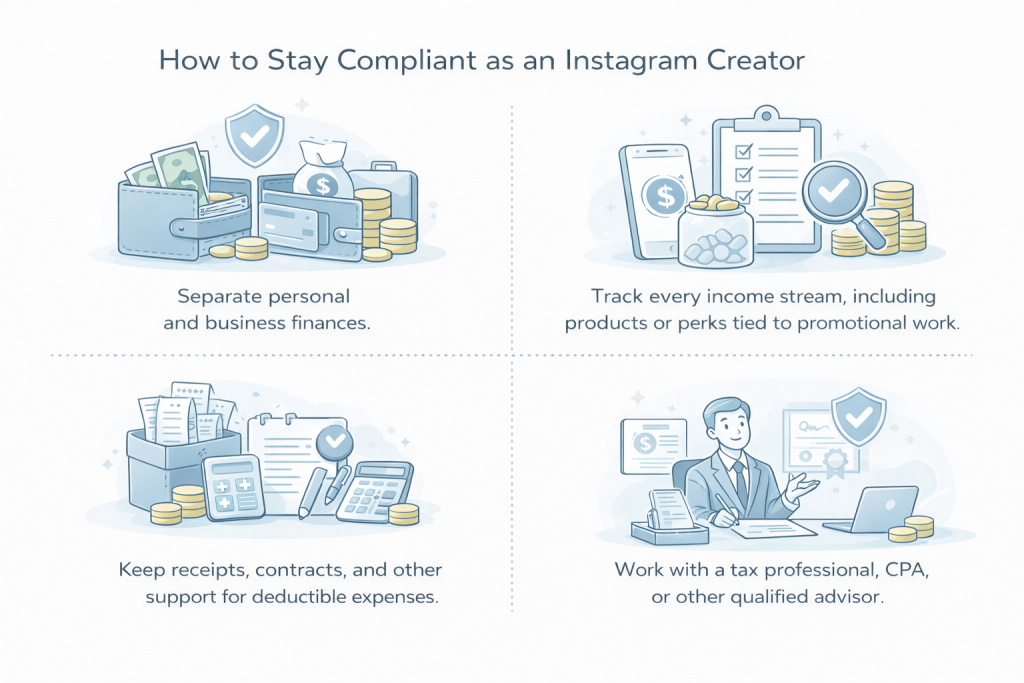
The strongest creator businesses usually make compliance boring on purpose. They separate personal and business activity early, they maintain a dedicated bank account, they reconcile payments from platforms and brands, and they document non-cash compensation where relevant. The reason this works is not just administrative cleanliness. It protects strategic clarity. A creator who understands exactly what came in, what was spent, and what remains exposed to tax can make far better decisions about partnerships, pricing, and which monetization streams deserve more attention.
A short summary is useful here because the topic gets dense:
- Separate personal and business finances.
- Track every income stream, including products or perks tied to promotional work.
- Keep receipts, contracts, and other support for deductible expenses.
- Save money during the year for estimated tax payments or other expected obligations.
- Work with a tax professional, CPA, or other qualified advisor before the business becomes too complex to untangle.
This is also the place where creator finance becomes unmistakably operational. Tax preparation is easier when the books are clean. Filing taxes is easier when the evidence trail exists. Tax planning is more useful when the business is not reconstructed from memory at tax time. And the emotional difference matters too: creators who reserve cash throughout the tax year are much less likely to experience a surprise tax bill that wipes out the perceived win from a strong revenue month.
“A creator should consult a tax professional once income becomes regular, exceeds a modest threshold, involves contracts, includes international payments, or when receiving significant non-cash compensation.” — William Eckhart, CPA
Common Tax Mistakes Instagram Creators Make
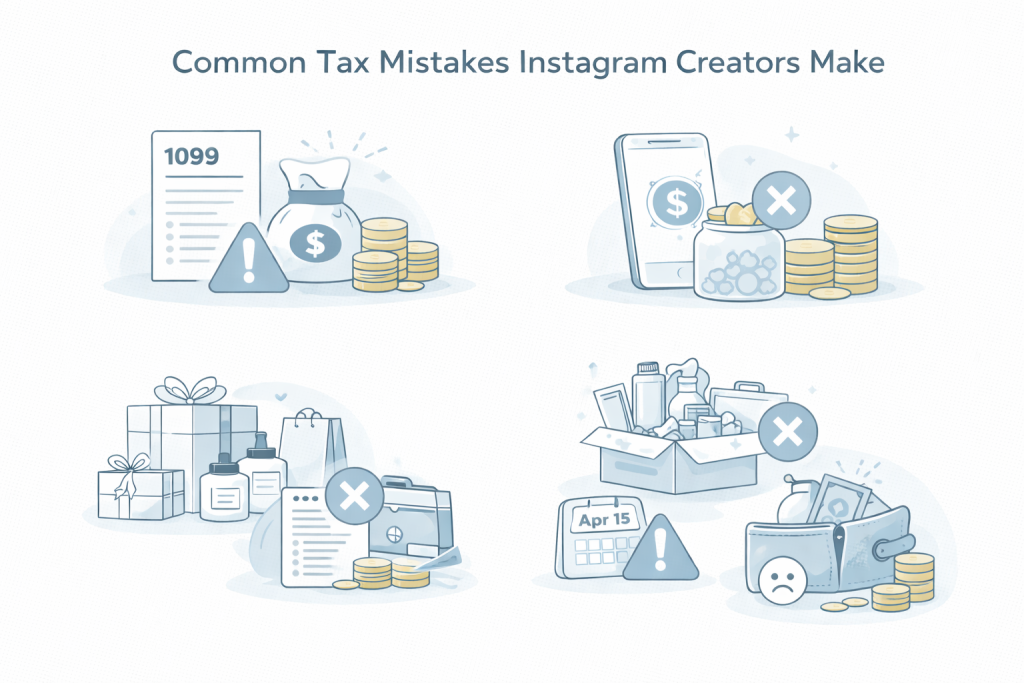
Most creator tax mistakes are not sophisticated. They are accumulation mistakes. A creator gets paid through several channels, maybe by direct deposit and Paypal, receives a few products, pays for tools, takes a partially business-related trip, and assumes they will sort it out later. Later usually arrives during tax season, when reconstructing the year becomes harder and more expensive than simply tracking it in real time.
“Common tax mistakes include failing to report all income, assuming small payments are exempt, not tracking gifted products, and mixing personal and business expenses. Many creators underestimate quarterly tax obligations and fail to set aside funds for income tax and self-employment tax.” — William Eckhart, CPA
The deeper problem is that creators often mature faster on the audience side than on the finance side. They can master Instagram best practices, understand how instagram algorithm works, develop stronger UGC examples on Instagram, and improve conversion through Shoppable UGC, yet still operate with weak internal controls. That is the creator-economy version of a retailer scaling traffic before solving fulfillment or returns. Success exposes the underlying fragility.
How Taxes Fit Into Instagram Monetization Strategy
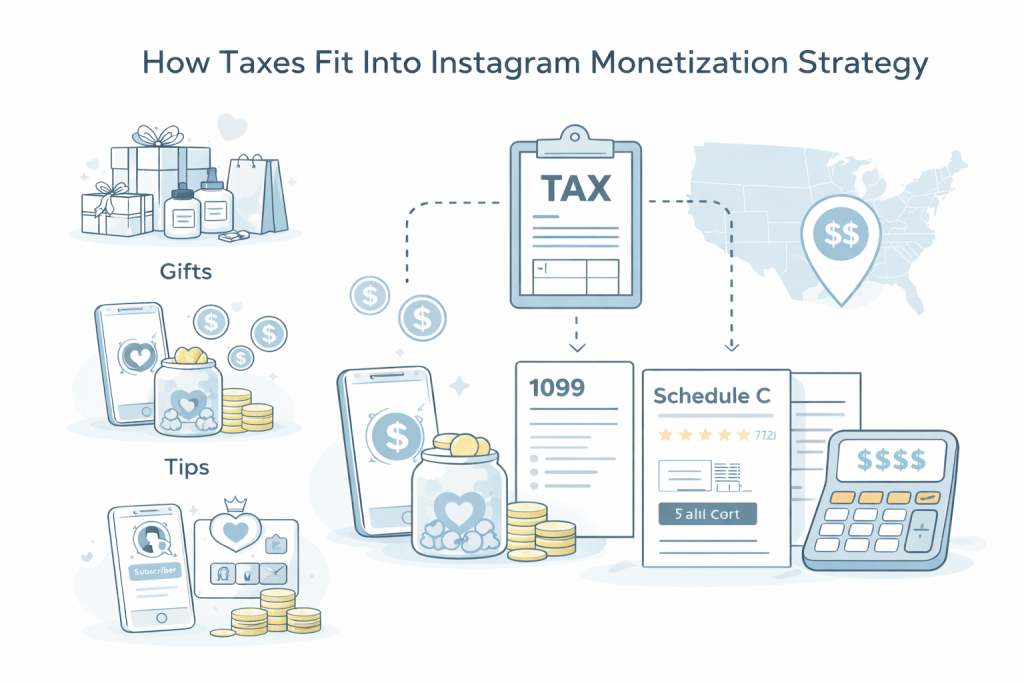
This is the section where tax becomes a strategy topic, not just a compliance topic. A creator deciding how to allocate time across Instagram monetization, Tiktok monetization, direct commerce, affiliate marketing, and brand partnerships is making portfolio decisions. Those decisions should not be evaluated only on topline revenue. They should be evaluated on retained profit after production cost, admin overhead, and tax. That is especially true for creators comparing Instagram vs. Tiktok Monetization, because the platform with the fastest apparent growth is not always the one with the strongest durable economics.
The same applies to trust and conversion design. Shoppable content works because it reduces the distance between proof and purchase. Shoppable instagram journeys supported by Instagram shopping integrations and connected storefronts can create a much more efficient flow from interest to transaction. Shoppable galleries and creator-led product proof can make that flow feel more native and credible. But the more a creator business starts to look like commerce, the more it inherits commerce’s back-office realities. Revenue quality, recordkeeping, attribution, and tax treatment start to matter just as much as reach.
A useful mini-case is the creator who begins with a few sponsored posts, then improves their process. They identify profitable Instagram niches, sharpen their production, start using affiliate marketing, and eventually build a storefront path after they Link shopify to instagram. Next comes more inbound from brands, more PR product, more recurring payments, maybe a test on Tiktok, maybe a subscription business, maybe even spillover revenue into onlyfans. Commercially, this looks like success. Operationally, it becomes dangerous if no one is tracking what was paid, what was gifted, what was reimbursed, which travel expenses were really for business purposes, or what share of revenue must be reserved for tax. That is how fast-growing creator businesses end up with impressive gross income and disappointing cash retention.
Final Thoughts
The creator economy now looks much more like commerce than casual social media. A creator may begin by experimenting with influencers, improving Instagram best practices, and publishing into strong Instagram niches. But once they start earning through brand deals, affiliate marketing, Shoppable UGC, and connected storefronts, the business stops being “just content.” It becomes a system that has to balance growth, trust, conversion, and compliance all at once.
That is the right frame for publishing a serious article on Instagram tax creators or influencer tax. The value is not in making tax feel easy. The value is in making the operating reality legible. The strongest creator businesses are usually not the ones with the loudest revenue claims. They are the ones that can explain where the money came from, what counted as taxable income, which costs were real business expenses, what tax deductions are supportable, and how they are planning for the next filing cycle before tax time arrives. That is what turns a creator from a busy earner into a durable business owner.
Reviewed using CPA guidance provided by William Eckhart for classification, barter income, common creator tax mistakes, deduction caveats, and compliance framing.
FAQs
Do Instagram influencers pay taxes?
Generally yes. In both the United States and Canada, profit-oriented Instagram income is generally taxable and often treated as self-employment or business income.
Do I have to pay tax on Instagram?
Usually yes, if you earn money or receive value through your Instagram activity, including sponsorships, commissions, bonuses, subscriptions, and some product-based compensation.
Do I need to file taxes from money I made on Instagram?
Often yes. In the U.S., the IRS says self-employed individuals generally must file if net self-employment earnings are $400 or more. In Canada, profit-oriented self-employed income must generally be reported.
How to do taxes as a content creator?
Treat the operation like a business. Separate accounts, track all income streams, keep receipts and support, preserve detailed records, and work with a tax pro or tax professional when complexity increases. The specific filing mechanics differ between countries, but the discipline is similar.
What Is Tax Deductible for an Influencer?
Potentially deductible costs may include legitimate tools, software, contractor support, and other deductible business expenses incurred for real business purposes, subject to local rules and documentation requirements.
Do Influencers Get Tax Write-Offs?
They may claim valid tax write-offs, but only where the expense truly qualifies as a business cost. Personal spending does not become deductible just because it appears in content.
How do I file taxes on this income?
In the U.S., creators often report on Schedule C and may owe self-employment tax. In Canada, creators generally report self-employed or business income through CRA reporting. Specific treatment depends on the facts, which is why personalized advice belongs with a professional, not a general article.
How do Instagram creators report income on taxes?
They typically report it as self-employment or business income, supported by their own books and any tax forms they receive. In the U.S., Form 1099-NEC may be relevant for nonemployee compensation.
How do Instagram creators report their earnings to the IRS?
Often through annual filing as self-employed individuals, commonly using Schedule C, while also accounting for self-employment tax where applicable.
Do I have to worry about the gift tax if I give my son $75,000 toward a down payment?
This is separate from creator income. In Canada, there is generally no standalone gift tax in the same way there is in the U.S. In the United States, gift tax has its own rules, exclusions, and filing issues, so this is one of those questions that should go directly to a CPA or other qualified advisor. A public article can safely say the jurisdiction matters a lot, but it should not pretend this is a one-line answer.