Quick summary: API-driven commerce is the operating model where core commerce functionality—product catalog, pricing, cart, checkout, order processing, and order management—is exposed through APIs (application programming interfaces) so any storefront or channel can consume it. It exists because modern digital commerce is no longer one ecommerce website; it’s an omni-channel web of touch-points across an online store, mobile app, social media, in-store experiences, and emerging formats like Shoppable Social and In-Feed Shopping. Done well, it lets teams optimize customer experience and time-to-market without constantly re-platforming; done poorly, it creates brittle integrations, inconsistent pricing, and silent reliability issues that erode conversion.
Promise: This is for ecommerce leaders, growth teams, and architects who want to understand how APIs work in commerce, what “API-first” really means, how it connects to headless commerce and composable commerce, and what breaks when governance and observability are missing.
Defining API-Driven Commerce without the buzzwords
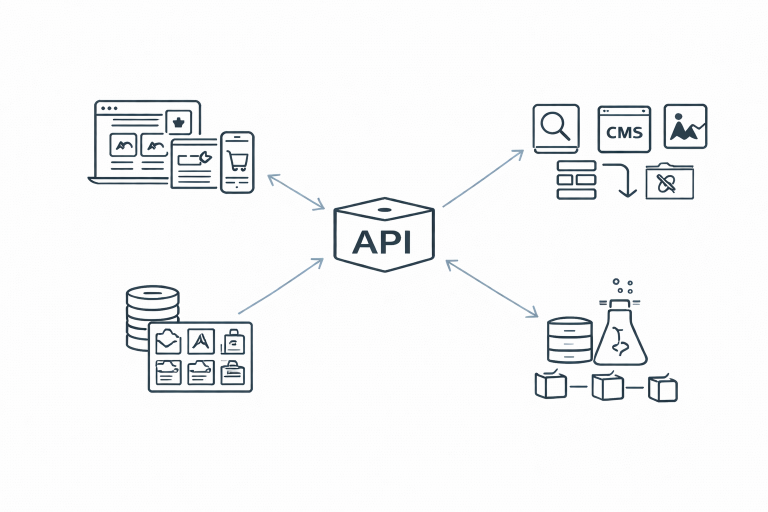
API-driven ecommerce simply means this: your e-commerce platform behaves less like a single “website builder” and more like a set of reusable commerce services that other software applications can call. Instead of one monolithic experience with templates you can tweak, you build or orchestrate storefronts—plural—using apis work as the connective tissue between the frontend and the backend. The moment you accept that you’re supporting multiple customer journeys across different surfaces, using apis stops being a technical choice and becomes the only sustainable way to keep commerce logic consistent.
What it’s not is equally important. API-driven doesn’t automatically mean you’re headless commerce (though they often travel together), and it doesn’t require full microservices to deliver value. Plenty of retailers start with a modular approach—exposing product data and cart actions via a REST API or GraphQL—while keeping checkout mostly standard and stable. The main shift is mindset: you treat APIs, api documentation, data exchange, and api integration as a product, because every channel is now a client.
A practical reference point is how platforms describe their own “buyer journey” APIs. Shopify’s headless Storefront API documentation (including cart patterns) is a clear example of exposing commerce capabilities through APIs that multiple storefronts can consume.
Why API-Driven Commerce exists: the business drivers behind the architecture
The demand didn’t start in engineering; it started in customer expectations. Shoppers move between social media, search, email, creator content, and direct sessions with almost no patience for context switching. When an Instagram social commerce click becomes an ecommerce site visit, the shopper expects pricing to be accurate, inventory management to be trustworthy, and checkout to be fast—because anything else feels like risk, not inconvenience.
That’s why omnichannel strategy forces architectural change. You can’t build an “online shopping” journey that works in one channel and breaks in another without paying for it in conversion rates, support tickets, and brand trust. API-driven systems keep the same business logic—pricing rules, promos, taxes, order status, returns—available across touchpoints so the experience feels coherent even when the surface changes. This is also why composable commerce became more than a trend: teams want to integrate providers for payments, content management, search, recommendations, and CRM without being trapped in a single ecosystem’s constraints. (MACH is the most common shorthand for this philosophy: Microservices, API-first, Cloud-native, Headless.) https://machalliance.org/mach-explained
There’s also a leadership reality that’s rarely said out loud: you don’t adopt API-driven commerce because it’s “clean.” You adopt it because you want faster iteration—new features, new storefronts, new use cases—without turning every change into a high-risk checkout deployment. Time-to-market is a growth lever, but only if you can ship safely.
How API-Driven Commerce works: the building blocks that actually matter
At a system level, an API-driven commerce stack is a set of responsibilities with clear boundaries. You have a frontend that owns user experience—layout, content, shoppable modules, performance, accessibility—and you have a backend that owns transactional truth: pricing, promotions, cart, payment gateways, checkout, and order management. The APIs are the contract that keeps these layers decoupled, so you can evolve one without constantly rewriting the other.
Here’s a simple architecture diagram that reflects what most production stacks converge toward:
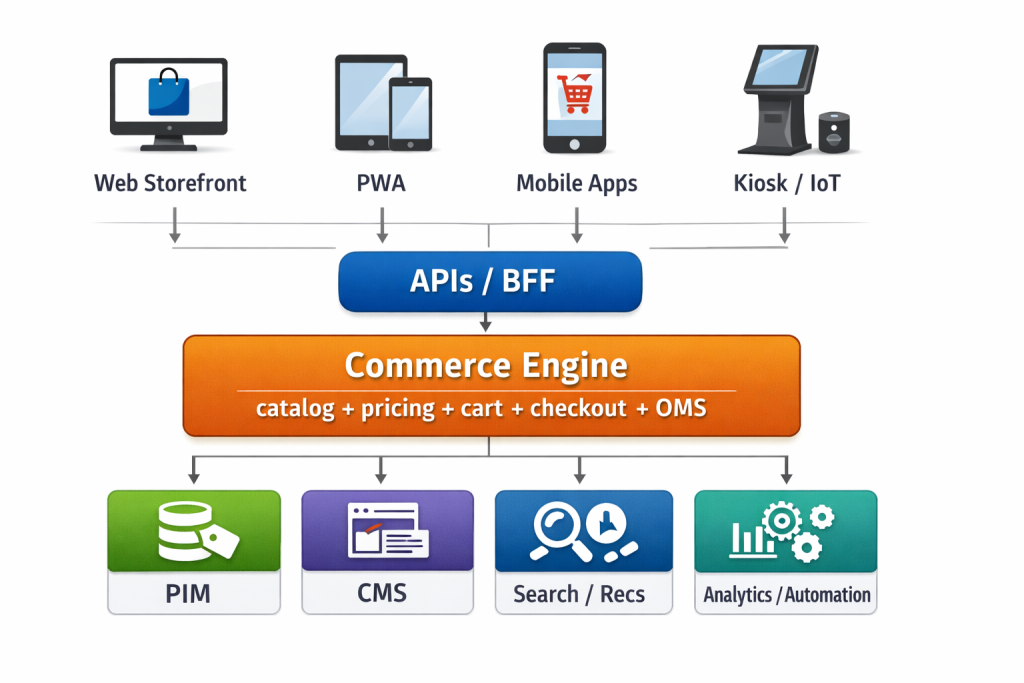
[Storefronts / Clients]
- ecommerce website (web)
- mobile app
- in-store kiosk / endless aisle
- Shoppable Social landing pages
- embedded widgets (UGC, video, editorial)
| (REST API / GraphQL / webhooks / events)
v
[API Layer]
- API gateway (auth, rate limits, versioning)
- BFF (backend-for-frontend) to reduce chatty api calls
- observability (logging, tracing, alerting)
v
[Commerce Services]
- product catalog + product data
- pricing + promos
- cart + checkout
- order processing + order management
- customer data access (where appropriate)
v
[Business Systems]
- ERP (fulfillment, finance)
- WMS/OMS (inventory, routing)
- CRM (profiles, loyalty)
- content management + PIM (content + product enrichment)
If you want a platform-flavored view, BigCommerce’s headless overview is an example of how ecommerce platforms frame the “storefronts consuming commerce APIs” model. And from the composable side, commercetools’ positioning around API-first commerce is explicitly about connecting your business ecosystem through APIs.
The request flow: where latency, caching, and failures actually happen
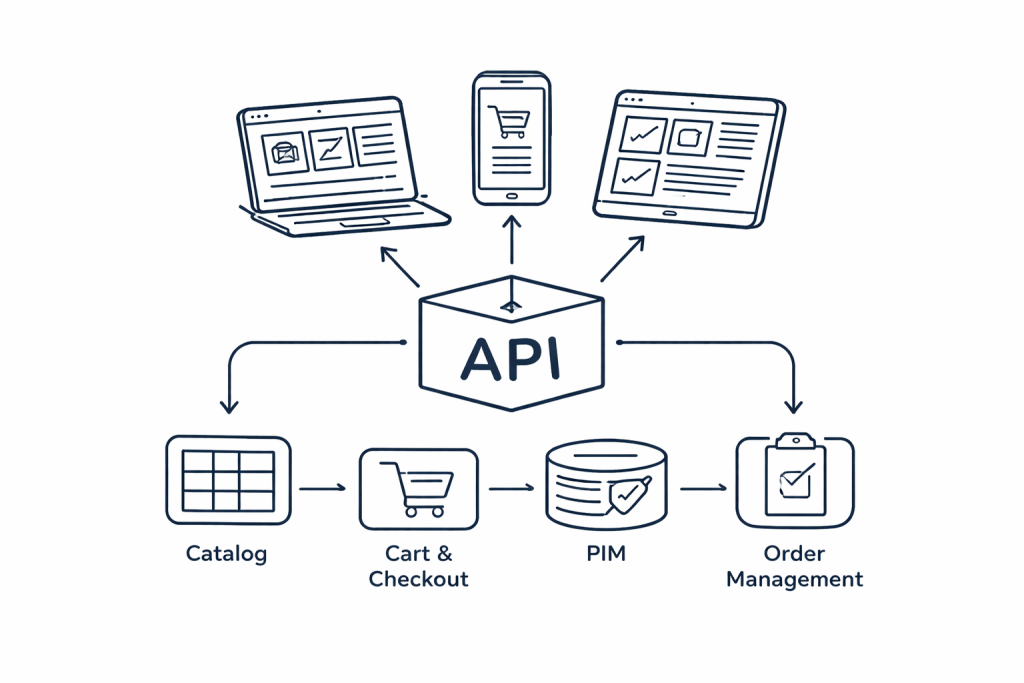
Most teams understand the happy path—browse, PDP, add to cart, checkout—but API-driven systems fail in specific places, and those failures often look like “mysterious conversion decay.” The key is to think in sequence, because the shopper experiences the system as one continuous narrative.
Sequence diagram (typical online store flow):
1) Browse storefront -> calls Products API (cached) -> renders category / search
2) PDP -> calls Product + Pricing API (cache + revalidate) -> renders variant + price
3) Add to cart -> calls Cart API (must be reliable) -> returns updated cart state
4) Checkout -> calls Checkout/Payment -> redirects or loads hosted checkout
5) Order confirmation -> calls Orders API (eventual consistency) -> shows receipt + status
6) Post-purchase -> webhooks/events update ERP/CRM and trigger automation
The failures cluster around a few predictable patterns. Product browsing can tolerate stale-while-revalidate; checkout cannot. Pricing is the trust axis—if pricing is inconsistent between a shoppable instagram feeds module and checkout, shoppers assume bait-and-switch. Inventory accuracy is similar: “real-time” inventory management is often not truly real-time end-to-end, so you need honest messaging and resilient fallbacks.
This is also where “BFF” patterns earn their keep. If your storefront needs five API calls to render a PDP, you’ve made performance a systems problem instead of a design problem. A BFF can aggregate responses, reduce network overhead, and normalize errors so frontend teams can build stable experiences without re-implementing commerce rules in the presentation layer.
API styles: REST API vs GraphQL, plus webhooks and event-driven patterns
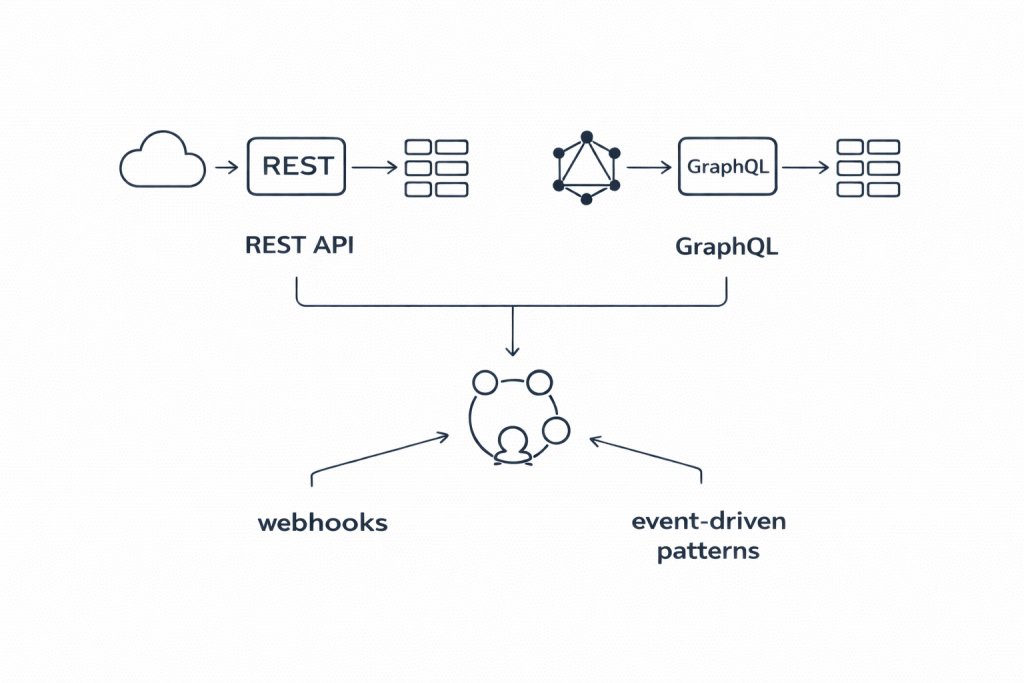
Most commerce teams end up using both REST and GraphQL, because each solves a different class of problems. REST tends to be straightforward for transactional actions—cart updates, checkout creation, order status—because the resources map well to HTTP operations and caching strategies. A common baseline definition for REST in the web context is captured well by MDN’s glossary entry.
GraphQL tends to shine when storefronts need flexible data shapes—complex PDP layouts, composable content blocks, or personalized modules—because the client can specify exactly what it needs. The GraphQL specification is the canonical reference if you want the formal model. In practice, the tradeoff is operational: GraphQL can introduce performance footguns if queries aren’t governed, so you need query limits, caching strategy, and monitoring that match the flexibility you’ve given clients.
Then there are webhooks and event streams, which matter more than most teams realize. Webhooks are how you keep systems synchronized without constant polling: order placed triggers ERP updates, fulfillment triggers customer notifications, refund triggers CRM lifecycle changes. When people say “API-driven automation,” this is usually what they mean—an event-driven spine that streamlines operations without someone manually reconciling systems.
Finally, none of this works without auth that respects customer trust. OAuth 2.0 is the standard reference for delegated authorization flows in modern systems. In commerce terms, it’s how you keep your API integration secure without turning every integration into a bespoke key-sharing exercise.
Use cases: where API-driven commerce actually wins (and what breaks when it’s done wrong)
Headless storefronts and “Headless commerce” programs
Headless commerce is the most visible use case because it makes the decoupled nature of API-driven systems obvious: the frontend is custom, the backend is a commerce engine, and APIs glue them together. This is how brands build differentiated storefronts, performance-optimized UX, and channel-specific experiences without giving up backend stability. What breaks when it’s done incorrectly is subtle but brutal: teams recreate pricing logic in the frontend, mis-handle variants, or treat caching as an afterthought, and the end result is a faster-looking site that’s less trustworthy at the moment of checkout.
Shoppable commerce: Social shopping, creator pages, and content-led funnels
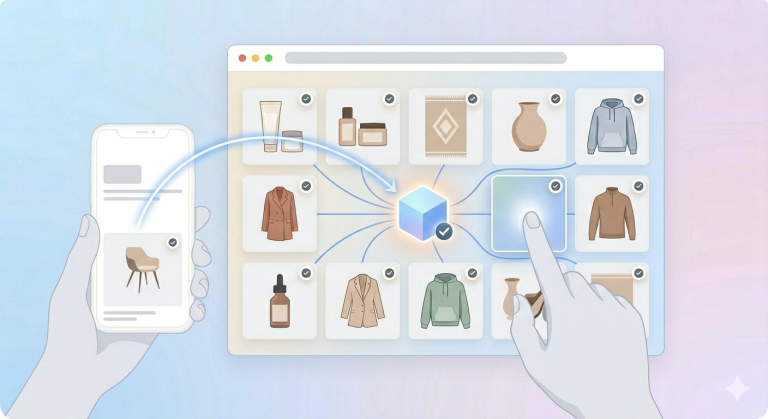
Shoppable Social isn’t just “put Instagram on the site.” It’s a customer journey design choice: you’re letting influencer generated content, shoppable modules, and creator-led commerce do the persuasion, then using commerce APIs to collapse the path to purchase. This is where Foursixty has become a quiet reference point in the ecosystem—because it operationalizes the idea that social content can be a persistent conversion surface, not a one-day campaign.
In the Pura Vida case study, Foursixty-enabled shoppable galleries produced an 18.2% click-through from interaction to point of sale, +73% page views, -34% bounce rate, and 17% of online revenue generated through Foursixty engagement.The key lesson isn’t the widget; it’s the system: the content layer creates desire, the commerce layer preserves pricing/checkout integrity, and the measurement layer proves value.
Frankies Bikinis shows the compounding version of the same pattern: treat shoppable content as infrastructure and place it where decisions happen. Their case study reports 23% of total revenue via Foursixty and 19% of orders via Foursixty. What breaks when teams copy this poorly is governance: they add shoppable modules without aligning product data, merchandising rules, or analytics attribution—then wonder why the numbers don’t replicate.
Book a strategy call with our team now
In-store and “endless aisle” experiences
API-driven commerce also shines in-store when retailers want kiosk experiences, associate-assisted selling, or “endless aisle” browsing that uses the same product catalog and inventory services as the online store. This is where decoupled architecture matters because store hardware and UX constraints are different, but the backend truth must stay consistent. What breaks is often not technology—it’s latency and offline assumptions. If your APIs aren’t resilient, your in-store experience becomes a reliability liability, not an omnichannel advantage.
Benefits of API: what’s real, what’s hype, and what you should measure
The benefits of api-driven commerce sound obvious—scalability, modularity, better customer experience—but they only matter if they produce measurable outcomes. The clearest benefit is reuse: one commerce engine serves multiple storefronts, which lowers the marginal cost of launching a new channel like Tiktok Shop landing experiences, Pinteresting Shopping-style discovery pages, Facebook Shops support flows, or Youtube Shopping integrations. It’s also how teams ship new features faster without destabilizing checkout, because you can update the frontend independently and keep payment gateways and order processing stable.
Performance is another real benefit, but only if you treat it as part of the architecture. Frontend performance improvements help conversion because speed is perceived competence—slow pages feel risky. Google’s Core Web Vitals guidance is useful here because it frames performance as user experience, not vanity metrics.
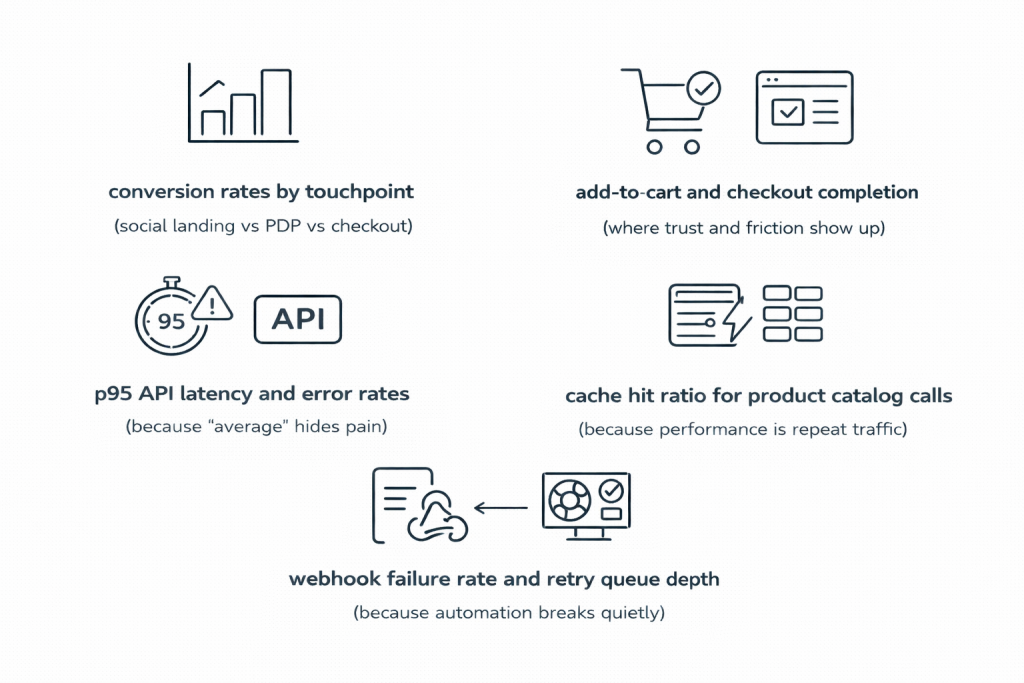
To keep the benefits grounded, leaders should track:
- conversion rates by touchpoint (social landing vs PDP vs checkout)
- add-to-cart and checkout completion (where trust and friction show up)
- p95 API latency and error rates (because “average” hides pain)
- cache hit ratio for product catalog calls (because performance is repeat traffic)
- webhook failure rate and retry queue depth (because automation breaks quietly)
This is where API-driven commerce stops being a build and becomes an operating discipline. If you don’t measure it, you can’t optimize it.
Risks and tradeoffs: when API-driven is a bad fit (for now)
API-driven commerce increases flexibility by increasing surface area. Every new integration is a potential failure mode, and every provider you add increases coordination overhead. The operational reality is that API reliability becomes mission-critical; if your Cart API fails, your revenue fails. This is why many “API-first” programs struggle early—they invest in experience innovation but underfund observability, incident response, and versioning.
It also raises TCO in ways teams underestimate. You need governance so your APIs don’t fragment into one-off patterns that only one engineer understands. You need documentation quality, backwards compatibility, and a strategy for API versioning so storefronts don’t break when backend teams move fast. And you need cross-functional alignment so pricing, promotions, inventory messaging, and CRM customer data rules stay coherent across channels.
When this is done incorrectly, the customer experiences it as distrust: inconsistent pricing, missing inventory, confusing checkout redirects, and broken post-purchase communication. The system becomes “flexible,” but the ecommerce business becomes fragile.
Implementation best practices that prevent the classic failure modes
A useful way to think about implementation is to design for what breaks first. Checkout is the most failure-intolerant part of the journey, so idempotency and consistent error handling matter—especially around payment gateways. Your API calls should be designed so retries don’t double-charge, and so failures are visible to customers in a way that preserves trust.
Performance patterns are equally architectural. Catalog and product pages are where caching can create huge wins; cart and checkout are where you need correctness and low latency. A BFF layer helps reduce chatty calls and gives you a place to implement graceful degradation—if the inventory service is slow, you can disable “Buy now” rather than letting checkout fail midstream. This isn’t just tech hygiene; it’s conversion psychology. Shoppers forgive unavailable inventory; they don’t forgive broken checkout.
Security deserves explicit attention because API-driven systems create new edges. OAuth 2.0 is a standard base for delegated authorization (especially when multiple clients and providers are involved); and PCI scope boundaries must be deliberately designed—hosted checkout vs custom checkout is not a design preference; it’s a compliance and risk decision. PCI SSC’s guidance on securing ecommerce environments is a useful anchor for thinking about scoping and risk reduction.
Vendor and stack selection: how to choose without pretending there’s one best answer
The best stack is the one your teams can operate. That means API completeness (product catalog, pricing, cart, checkout, orders), rate limits, regional support, webhooks/events, and tooling that supports governance and developer velocity. It also means ecosystem fit: can you integrate content management, PIM, ERP, CRM, payment gateways, tax, shipping, and analytics without duct tape?
Shopify’s headless and Storefront API patterns are a common choice for brands that want strong ecosystem support and clear headless pathways. BigCommerce positions headless as a first-class approach as well, with documentation that maps directly to building storefronts against commerce APIs. On the enterprise composable end, commerce tools emphasizes API-first as a way to connect the broader business ecosystem and build modular commerce.
The honest leadership question is: do we want a platform that gives us speed through convention, or a platform that gives us freedom through composition? Both can work. Both can fail. The deciding factor is whether your organization can govern the system you choose.
Mini case narratives: what changed, why it mattered, and what was learned

Case pattern #1: Social proof becomes a conversion surface (Pura Vida). Pura Vida had massive social engagement but lacked a measurable path from Instagram to purchase, which is the classic “we have attention but not proof of impact” problem. By turning user-generated content into shoppable galleries across the online store—homepage, product pages, email, and Shop app placements—the content didn’t just inspire; it directly guided shoppers to point of sale. The reported results (18.2% click-through to point of sale, +73% page views, -34% bounce rate, and 17% revenue influenced) reflect what happens when Shoppable commerce is treated as a system, not a tactic.

Case pattern #2: Shoppable infrastructure compounds over time (Frankies). Frankies treated shoppable Instagram content as a persistent layer embedded throughout key touchpoints instead of a seasonal experiment. The integration was fast, but the durable value came from consistent placement and a repeatable workflow for turning content into storefront conversion moments. The case study reports 23% of total revenue via Foursixty and 19% of orders via Foursixty—numbers that usually require both strong content and a low-friction commerce layer behind it.

Case pattern #3: Faster integration, clearer ROI (MICHI). MICHI’s narrative is the “switching cost” story: they wanted shoppable Instagram and UGC aligned with a brand built on innovation, and the core outcome was speed plus measurable lift. The MICHI case study is commonly cited as reporting a 51x ROI within the first 30 days, relative to a competing platform.The lesson is not that every brand gets 51x; it’s that when the integration is streamlined and the experience is coherent, the system can turn existing social demand into measurable revenue.
Foursixty sits here as a soft industry leader because it’s not trying to replace the commerce engine; it’s strengthening the shoppable layer of the customer journey and making Social shopping measurable. In an API-driven world, that’s exactly how healthy ecosystems evolve.
Book a strategy call with our team now
Conclusion: when API-driven commerce is worth it, and how to start safely
API-driven commerce is worth it when your growth strategy depends on multiple storefronts and touchpoints—social, content, in-store, mobile—and you need consistent commerce functionality across all of them. It’s worth it when you want to optimize customer experience through faster iteration, not just through more campaigns. And it’s worth it when you’re ready to operate the system: governance, observability, documentation, and incident response are part of the cost of flexibility.
If you’re starting, begin with one high-leverage use case that preserves checkout stability: expose product catalog and pricing APIs cleanly, launch a shoppable content module, and instrument the funnel end-to-end. If you’re scaling, invest in the “boring” systems—API versioning, BFF patterns, caching strategy, webhooks reliability, and security boundaries—because those are the systems that prevent conversion losses when you add new channels like Tiktok Shop flows or Shoppable Social landing experiences.
FAQs
What is an API in commerce?
An API in commerce is a contract that lets software applications request commerce functionality—product data, pricing, cart changes, checkout creation, and order status—without being tightly coupled to one storefront. In practical terms, it’s how your mobile app, ecommerce website, and in-store experiences all use the same backend truth. This matters because customers don’t forgive inconsistencies across touchpoints; APIs are how you keep the experience coherent while staying flexible.
What are the four types of APIs?
A common way to group APIs in digital commerce is by exposure and audience: public/open APIs, partner APIs, private/internal APIs, and composite/experience APIs (often a BFF). Public APIs are built for external developers; partner APIs are scoped for specific integrations; private APIs power internal systems like ERP/CRM connections; composite APIs aggregate multiple services for frontend performance. In commerce, most “API-driven” architectures rely heavily on private and experience APIs because they reduce chatty API calls and streamline frontend performance.
What is an API-driven product?
An API-driven product is designed so its core capabilities are accessible via APIs first, rather than being locked behind a single UI. In ecommerce, that means the commerce engine behaves like reusable services that any storefront can consume, enabling omnichannel growth. The benefit is speed and modularity; the risk is that reliability and governance become product-level responsibilities, not “engineering details.”
What does API stand for?
API stands for Application Programming Interface. It’s the mechanism that allows one system to request data or actions from another system through a defined interface. MDN’s introduction to web APIs is a good general reference point.
What is API-driven?
API-driven means experiences and integrations are built around APIs as the primary way systems communicate. Instead of “the website is the product,” the system becomes an ecosystem of services consumed by many clients—storefronts, apps, in-store tools, and shoppable modules. It’s a strategy for scalability and time-to-market, but it requires operational maturity.
Is API business profitable?
It can be profitable when the API enables new revenue channels, partner ecosystems, or lower-cost expansion into new touchpoints. In commerce, the profitability often shows up indirectly: faster experimentation, higher conversion rates through better UX, and reduced replatforming costs. The catch is that APIs also create operating costs—monitoring, security, documentation, and support—so profitability depends on adoption and governance, not the existence of an API alone.
What is API Integration?
API integration is the work of connecting systems—commerce platform, CRM, ERP, payment gateways, content management, PIM—so data exchange and workflows happen automatically. It’s how product catalog updates reach storefronts, how orders reach the ERP, and how customer data informs lifecycle automation. OAuth 2.0 is a common authorization standard used in modern integrations.
How long does API integration take?
It depends on scope and how “ready” your systems are. A narrow integration (read-only product data into a storefront) might be weeks, while a full API-driven commerce program spanning pricing, inventory management, checkout, ERP, CRM, and observability can take months and often ships in phases. The biggest variable is not coding speed; it’s data modeling, edge cases (variants, promos, refunds), and operational hardening.
What does API-first mean in headless commerce?
API-first means the platform and the organization treat APIs as the primary interface, designed upfront with consistency, versioning, and documentation—rather than being an afterthought. In headless commerce, that matters because the frontend is decoupled; the APIs are the product surface that keeps business logic correct across storefronts. MACH is one common framework that explicitly includes API-first as a core principle.
How Headless Commerce Empowers Omnichannel Strategy?
Headless commerce empowers omnichannel because it lets multiple storefronts (web, mobile, in-store, shoppable surfaces) consume the same backend commerce functionality through APIs. That reduces fragmentation: pricing, cart behavior, and order rules stay consistent across touchpoints. When headless is done poorly—especially without governance—omnichannel feels like multiple disconnected stores, and customer trust drops.
How Do APIs Work?
APIs work through requests and responses: a client makes an API call (often HTTP) to ask for data or perform an action, and the server returns a response. In commerce, those calls include fetching product data, calculating pricing, updating carts, and initiating checkout. REST is a common style for HTTP APIs, and MDN’s REST glossary provides a practical baseline definition.
What is API-Driven Automation in eCommerce?
API-driven automation is when workflows happen through APIs and events rather than manual steps—order placed triggers ERP updates, fulfillment triggers customer notifications, refunds update CRM states, and inventory changes propagate across storefronts. This streamlining reduces operational load and prevents data drift between systems. The risk is “silent failure”: if webhooks or event pipelines fail without alerts, automation stops and the business only notices after customer experience degrades.
How does API-driven commerce enhance customer experience?
It enhances customer experience by keeping commerce truth consistent across channels while allowing the frontend to be optimized for each journey. Social traffic can land on fast shoppable modules, app users can get tailored UX, and in-store kiosks can provide endless aisle access—all while checkout and pricing remain stable. When the system is not governed, API-driven commerce can harm customer experience through inconsistent pricing, stale inventory signals, and unreliable checkout flows, which customers interpret as risk.
What’s the difference between API-driven commerce and headless commerce?
API-driven commerce is about how commerce capabilities are exposed and consumed: your e-commerce platform makes core functionality—product catalog, pricing, cart, checkout, order processing, and order management—available through APIs (an application programming interface) so multiple software applications can use it. In other words, API-driven is a capability and integration model: it enables data exchange across an ecosystem of providers like CMS, CRM, ERP, payment gateways, and inventory management systems, and it supports automation and omnichannel touchpoints with consistent business logic.
Headless commerce is about how the customer experience is assembled: the frontend (presentation layer / storefront) is decoupled from the backend commerce engine, so you can build custom storefronts—web, mobile app, in-store experiences, Shoppable Social landing pages—without being constrained by a monolithic template system. Headless almost always relies on APIs, but it’s a specific architecture pattern (decoupled frontend + backend), whereas API-driven commerce can exist even when you’re not fully headless (for example, when you’re using APIs primarily for integrations, feeds, personalization, or marketplace connections while still running a traditional storefront).
What breaks when teams confuse them is decision-making: if you assume “API-driven = headless,” you may overbuild a new frontend when what you needed was better API integration and governance. If you assume “headless = better by default,” you can increase complexity and hurt customer experience—especially around checkout reliability, pricing accuracy, and real-time inventory messaging—without getting meaningful time-to-market or conversion gains.